
Quick Summary
- Indian matrimony isn’t what it used to be, especially for people doing well in their careers.
- Old setups don’t always fit today’s fast, independent lifestyles.
- Work, personal space, and values matter a lot more now.
- Privacy has become a real concern, not just a preference.
- Clear communication is more important than simply completing tasks.
- A flexible approach usually works better.
- New-age platforms are quietly changing how people find partners.
For the longest time, Indian matrimony followed a pretty fixed pattern. Families would connect, biodatas would get shared, and things would move fast. And to be fair, it worked. Still does for many. But if you’re someone who’s spent years building a career, figuring out your life on your own terms, maybe living in different cities, and handling everything yourself, then this process can feel slightly off. Not completely wrong, but not fully fitting. Because now, you’re not just looking for a good match. You’re looking for someone who actually fits into your life. The life you’ve built with effort, long workdays, and yes, a lot of trial and error along the way. That’s where Indian matrimony in its older form starts to feel somewhat limited.
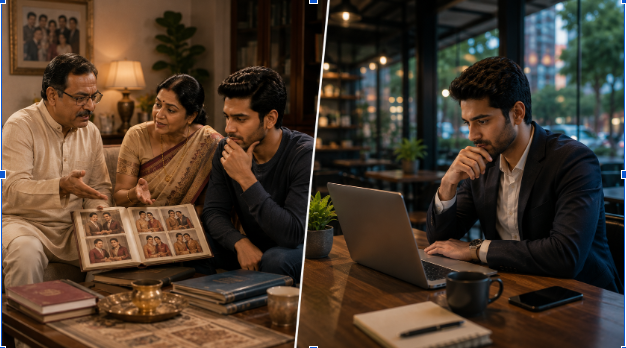
Traditional vs modern Indian matrimony approach
Why Old Ways in the Indian Matrimony Don’t Always Work
The traditional setup came from a time when life was simpler in some ways. Roles were clearer. Expectations were more predictable. Now everything’s a bit more layered. People think differently. Live differently. Want different things. So when the process stays the same, but people change, there’s bound to be a mismatch somewhere.
1. The Shift in Priorities
Earlier, Indian matrimony was mostly about stability. Good family, decent background, similar community. That was enough to move ahead. Now? That’s just step one. If you’re doing well in your career, your thinking probably goes beyond that. You start caring about things like the following:
- Will this person understand my work life?
- Do we see life in a similar way?
- Can we actually talk without it feeling forced?
And here’s the tricky part. Everything can look perfect on paper. But then you talk, and something feels off. You can’t always explain it, but you feel it. That gap matters more now than it used to.
2. Time Isn’t on Your Side
Between work, deadlines, maybe travel, and trying to have some personal life, there’s barely any space left. Now add traditional Indian matrimony expectations on top of that. Meeting families, repeating the same conversations, and starting from scratch again and again. It gets tiring fast. It almost starts feeling like a second job. And not a very rewarding one at that.
3. The Pressure to Fit a Mold
This pressure is often subtle, yet deeply embedded in the matchmaking experience. In many Indian matrimony setups, there exists a quiet but persistent expectation for individuals to fit into a preconceived mold, to adjust their personal aspirations, and to agree to a union simply because the external parameters appear ideal.
Common refrains used to encourage this conformity include:
- It’s a good family.
- Everything matches.
However, real life is rarely lived according to what is written on paper. If day-to-day thinking, personal habits, or long-term career and life plans are fundamentally misaligned, those differences do not simply vanish once the ceremony is over. Instead, they often manifest gradually, starting as small frictions in daily routines before escalating into significant challenges. Successful professionals today require more than just a surface-level match; they need a partner who complements their independent lifestyle and respects the personal space they have worked hard to establish.
4. Privacy Feels Missing
If you’ve ever been part of a traditional Indian matrimony process, you probably know this feeling. Too many people know too much, too quickly. Relatives, extended networks, family friends, and information move around. Sometimes, before you’ve even decided if you like the person. And that can feel uncomfortable. Especially if you’re used to keeping your personal life personal. Now compare that with setups where you control who sees your details, who you talk to, and how things move forward. It just feels calmer.
5. It’s Not About Checklists Anymore
There was a time when Indian matrimony worked on checklists. Age, height, salary, family background, etc. Now? That’s barely enough. You might meet someone who ticks every box, but the conversation feels dry. Then you meet someone else who maybe doesn’t fit perfectly on paper, but you just connect. Easy conversations, similar thinking, and respect. That’s not something you can measure neatly. But it’s what actually makes things work long-term.
A More Flexible Approach Helps
This doesn’t mean traditional Indian matrimony is outdated or useless. Not at all. It still works for many people. But if you’re someone who’s lived independently and made your own choices for years, you’ll probably need a slightly different approach.
Something that gives you:
- Structure, so things don’t feel random.
- Freedom, so you don’t feel boxed in.
A mix of both tends to work better. You can still involve family. Just at your own pace and in your own way.
Conclusion
Finding a partner has never really been easy. And honestly, it shouldn’t be rushed either. But the way you go about it can make a big difference. For many people today, especially those who’ve built their lives with intention, the older style of Indian matrimony can feel somewhat restrictive. Not wrong, just not fully aligned with how life looks now.
VIPShaadi is trying to change that quietly. They bring in more privacy, better matches, and a process that feels less overwhelming, which is why many now see them as part of a more updated and modern Indian matrimony experience. Before you jump in, just pause for a moment. Think about what actually matters to you. Not what sounds right, and not what others expect. Just what feels right in your everyday life. That clarity helps more than anything else.
FAQs
1. Why don’t traditional Indian matrimony methods always work today?
Because a lot of it still runs on basic filters. Family, background, a quick checklist, and done. But real life isn’t that simple anymore. People want a deeper connection now.
2. Is Indian matrimony still relevant for working professionals?
Most working professionals aren’t against the idea; they just want more control. Less noise, fewer forced conversations, and a setup where things move at a pace that actually fits into their already packed schedule.
3. How can I make Indian matrimony work better for me?
Start by being honest with yourself. Not what sounds right, but what actually matters to you. And don’t rush it.
4. Are modern platforms better than traditional ones?
Better, maybe not always. But easier? Often, yes. If you’re busy, juggling work and life, having something that lets you filter, choose, and talk on your own terms just feels more manageable. Less pressure. More clarity.
5. What should I focus on while choosing a partner?
Look beyond basic details. Pay attention to how you communicate, think, and understand each other.