
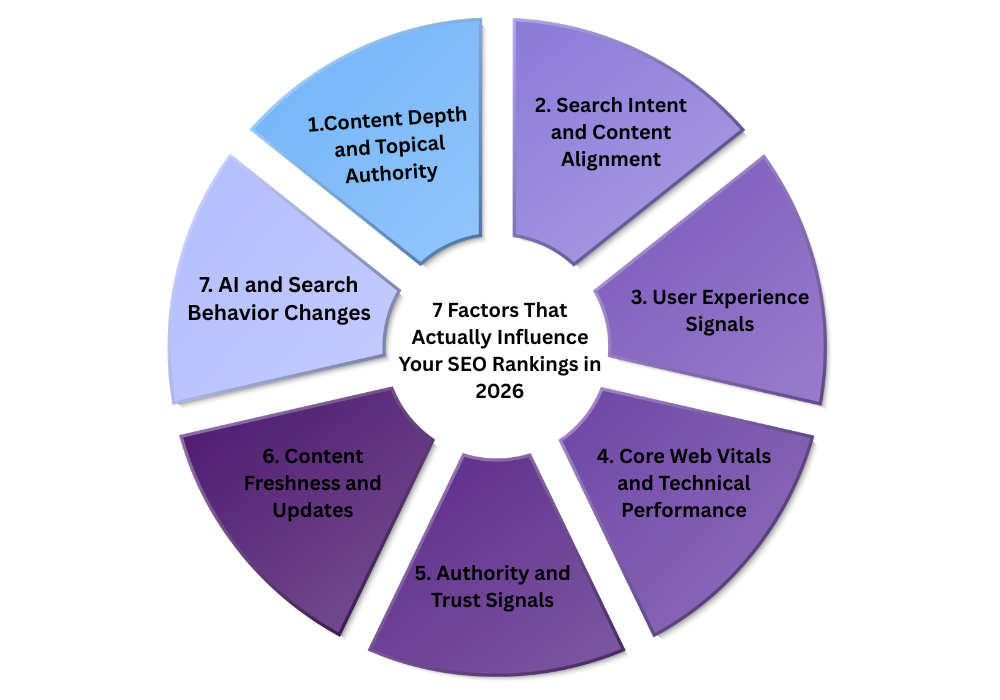
SEO rankings in 2026 are influenced by seven key factors: content depth and topical authority, search intent alignment, user experience signals, technical performance, authority and trust signals, content freshness, and evolving AI-driven search behavior. Together, these elements determine how well a website meets user expectations and how effectively it performs in search results.
SEO has become more strategic and layered over time. It is not just about keywords anymore. Businesses need to think about how people search, what they expect, and how search engines interpret those behaviors. This shift is especially important in digital marketing for small businesses, where competing with larger brands requires smarter, more focused strategies rather than bigger budgets.
In this article, we will see the seven factors mentioned above in detail.
1. Content Depth and Topical Authority
Search engines now favor websites that show deep expertise on a subject, not just one-off articles.
This means:
- Covering topics in detail, not just at the surface level
- Creating related content that builds a strong content network
- Answering follow-up questions that users may have
For example, instead of writing one blog post, successful sites build clusters of content around a core topic. This helps establish authority and improves overall rankings.
2. Search Intent and Content Alignment
Matching search intent is more precise than ever.
Search engines analyze:
- Whether your content answers the exact query
- If users stay on your page or return to search results
- How well your page satisfies the user’s needs
Even well-written content will not rank if it does not match what the user is actually looking for. Intent alignment is now a key ranking factor.
3. User Experience Signals
User behavior plays a major role in SEO performance.
Important signals include:
- Dwell time (how long users stay on your page)
- Bounce rate (whether they leave quickly)
- Interaction (scrolling, clicking, exploring more pages)
A page that keeps users engaged sends a strong positive signal. This is why layout, readability, and structure matter as much as the content itself.
4. Core Web Vitals and Technical Performance
Technical SEO is no longer optional. Performance directly affects rankings.
Key elements include the following:
- Page load speed
- Visual stability while loading
- Responsiveness to user input
A slow or unstable site frustrates users and lowers your ranking potential. Clean code, optimized images, and reliable hosting all contribute to better performance.
5. Authority and Trust Signals
Search engines evaluate how trustworthy your website appears.
This includes:
- High-quality backlinks from relevant sources
- Clear author information and credibility
- Accurate, fact-checked content
Authority is built over time. It is not just about links anymore, but also about consistency and reliability.
6. Content Freshness and Updates
Fresh content is still important, but it is more about relevance than frequency.
You should:
- Update outdated information
- Add new insights or data
- Improve existing pages instead of always creating new ones
Search engines reward content that stays accurate and useful over time.
7. AI and Search Behavior Changes
In 2026, AI-driven search plays a bigger role in how content is ranked.
Search engines now:
- Understand context better than exact keywords
- Analyze conversational queries
- Prioritize natural, human-like content
This means writing for people, not just algorithms. Content that feels natural and answers real questions performs better.
Why These Factors Matter More Now
The biggest shift in SEO is the focus on real user value.
Search engines are designed to:
- Deliver the best possible answer
- Reduce low-quality or misleading content
- Reward websites that users trust
This makes SEO more competitive but also fairer for businesses that focus on quality.
Key Takeaways
- SEO in 2026 is driven by user experience and content quality.
- Deep, topic-focused content performs better than isolated posts.
- Matching search intent is an important aspect of digital marketing for small businesses.
- Technical performance directly impacts visibility.
- Authority and trust take time but deliver long-term results.